
Google Ads AI Max Explained: Should Businesses Turn It On?
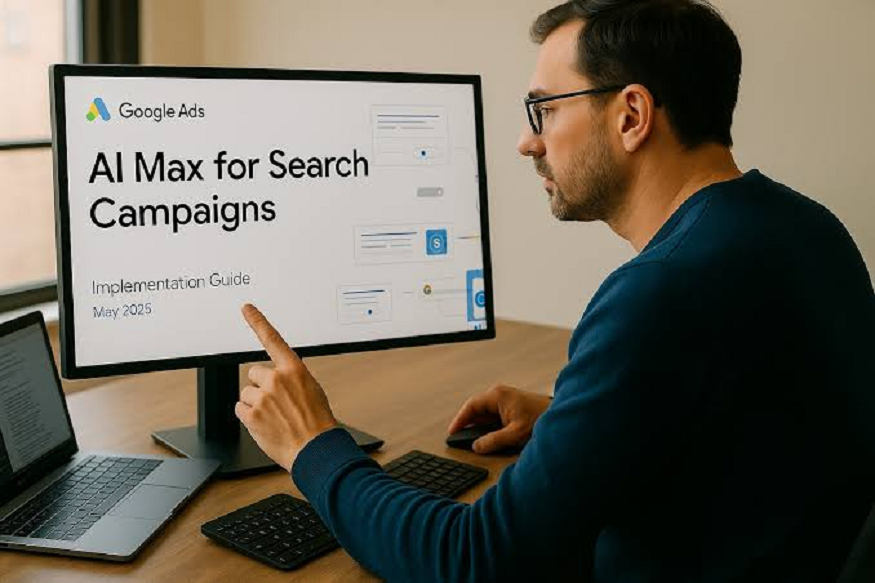
Google Ads AI Max gives Search campaigns more automation, reach and creative flexibility, but whether businesses should turn it on depends on the quality of their tracking, landing pages and conversion data.
Most businesses should test Google Ads AI Max before activating it across every Search campaign. AI Max can expand search coverage, adapt ad messaging and direct visitors to more relevant website pages. However, better automation does not automatically produce better leads.
The decision should be based on qualified leads, sales and Return On Ad Spend…not additional clicks.
What is AI Max for Google Search Campaigns?
Google Ads AI Max for Search campaigns is a group of targeting and creative enhancements available within existing Search campaigns. It is not a separate campaign type.
AI Max combines three primary capabilities:
- Search term matching: Expands campaign reach beyond existing keyword coverage.
- Text customization: Creates or adjusts ad assets using current advertisements and website content.
- Final URL expansion: May direct visitors to a website page Google considers more relevant to their intent.
In simple terms, AI Max can influence which searches trigger an ad, what that ad communicates, and which landing page the visitor reaches.
Businesses using Google Ads management should treat AI Max as an optimization layer, not a replacement for strategy, tracking or human oversight.
How Does Google Ads AI Max Work?
AI Max evaluates information from the campaign, advertisements, website, and recorded conversions.
Read More: Navigating the Shift Toward AI-Driven Marketing and Digital Transformation
The process follows four general stages:
1. It identifies additional relevant searches
AI Max uses broad-match and keywordless technology to connect advertisements with queries that may not be covered by the campaign’s existing keyword list.
This can help businesses reach customers who describe the same service in different or more conversational ways.
2. It adapts the advertisement
Google can identify relevant marketing messages from eligible website URLs and use them to create assets that complement the campaign’s existing advertisements.
The quality of the website matters. Thin, unclear or outdated pages provide weaker information for the system to use.
3. It selects a relevant landing page
With final URL expansion enabled, Google may replace the chosen landing page with another eligible URL that appears more relevant to the query.
4. It uses conversion results to optimize
The campaign’s bidding and targeting systems learn from recorded conversion actions.
The complete path is:
Search intent → Query match → Customized ad → Relevant URL → Conversion signal
Businesses should also test their tracking templates. Google warns that incompatible tracking configurations can cause expanded URLs to return broken pages or 404 errors.
What Are the Benefits of Turning on AI Max?
AI Max is designed to help established Search campaigns capture demand that manually selected keywords may miss.
| Benefit | Potential business value | Best suited for |
| Wider query coverage | Finds additional relevant searches | Campaigns ready to scale |
| Customized ad messaging | Improves alignment with user intent | Businesses offering several services |
| Final URL expansion | Connects users with specific pages | Websites with strong service content |
| Faster keyword discovery | Reveals new customer language | Actively managed accounts |
| Additional controls and reporting | Supports closer evaluation | Businesses monitoring lead quality |
Google has reported that some early advertisers achieved incremental conversions after enabling AI Max, although results from individual examples should not be treated as universal performance expectations.
The greatest opportunity may be AI Max for local service campaigns where customers use highly specific service, problem and location combinations.
What Are the Risks of Google Ads AI Max?
AI Max provides more flexibility, but that flexibility creates several risks.
Less predictable search traffic
Expanded matching may trigger advertisements for searches that seem relevant to Google but have little commercial value. Negative keywords, geographic settings and regular search-term reviews remain important.
Optimization toward poor-quality leads
Google can optimize for recorded conversions. It may not know whether a form submission was a genuine prospect, job applicant, vendor or spam enquiry.
A campaign can therefore report a lower cost per conversion while producing fewer profitable customers.
This case study demonstrates why conversion hierarchy matters. The campaign separated high-intent actions from secondary engagement and produced an 80.45% increase in conversions while reducing cost per conversion by 38.18%.
Reduced control over messaging
Text customization may create language that does not fully reflect the company’s preferred positioning. Legal, financial, medical and other regulated businesses require additional review.
Google has introduced text guidelines that allow advertisers to provide more direction for AI-generated assets, but advertisers remain responsible for accuracy and compliance.
Incorrect landing-page selection
Final URL expansion may send visitors to an outdated or inappropriate page unless exclusions are configured properly.
Businesses should correct website issues that cause paid traffic to lose leads before allowing Google greater control over landing-page selection.
Do not enable AI Max yet when tracking is unreliable, lead quality is unknown, website pages are outdated or generated assets cannot be reviewed regularly.
Should Your Business Turn on AI Max?
| Business situation | Recommendation |
| Profitable Search campaign with reliable conversion data | Run a controlled test |
| New campaign without a performance baseline | Wait and collect data |
| High volume of irrelevant leads | Fix lead tracking first |
| Strong service and location pages | Consider testing final URL expansion |
| Outdated or poorly organized website | Improve the website first |
| Strict legal or brand requirements | Test with tighter controls |
| No connection between leads and sales | Add offline conversion tracking first |
AI Max is best suited to businesses with stable Search campaigns, accurate tracking and useful website content. It is less suitable for advertisers that require absolute control over every query, message and landing page.
How to Test AI Max Without Losing Control
Use this seven-step framework:
- Record the current CPA, ROAS and qualified-lead rate.
- Confirm that primary conversions are accurate.
- Review all eligible website pages.
- Exclude irrelevant, outdated and sensitive URLs.
- Document brand and compliance restrictions.
- Activate AI Max in a suitable campaign or experiment.
- Compare qualified leads, sales and revenue against the baseline.
What is Changing with AI Max in 2026?
Starting in September 2026, Google will automatically move eligible campaigns using automatically created assets or campaign-level broad match to AI Max settings.
Read More: How AI Tools Are Transforming Digital Marketing Strategies
Google has extended the broader Dynamic Search Ads sunset and auto-upgrade timeline, which is scheduled to begin in February 2027.
Google is also expanding AI Max controls, reporting and creative features as Search becomes more conversational.
Businesses should review existing campaign settings before automatic changes begin.
The Bottom Line
AI Max should not be activated simply because Google recommends it.
Businesses with accurate conversion data, profitable Search campaigns and strong landing pages should test it methodically. Businesses without those foundations should improve measurement, lead quality and website content first.
The correct question is not whether AI Max generates more activity. It is whether it generates more profitable customers.
Frequently Asked Questions
Is Google Ads AI Max a separate campaign type?
No. AI Max is a collection of optional targeting and creative features used within a Google Search campaign. It can be enabled in a new campaign or added through the settings of an eligible existing campaign.
Does AI Max replace keywords?
No. Keywords still provide valuable campaign direction. AI Max can expand beyond the existing keyword list to identify additional queries based on user intent, campaign information and website content.
Can AI Max change the landing page in an ad?
Yes. Final URL expansion allows Google to select another eligible page on the same website when it predicts that page will better answer the user’s query. URL exclusions can limit which pages are available.
Is AI Max suitable for small businesses?
It can be, provided the business has reliable conversion tracking, useful landing pages and enough data to evaluate the results. A small budget combined with inaccurate tracking may make the test difficult to assess.
How should AI Max performance be measured?
Measure qualified leads, completed sales, cost per acquisition, revenue and ROAS. A rise in clicks, impressions or total form submissions does not prove that AI Max is improving business performance.