
India Proxy Guide: How to Buy a Reliable Indian Proxy
Would you like to make your traffic seem to originate from within India? Perhaps you’re looking to test a product in the Indian market, manage a variety of accounts across regions, or access information meant only for Indian citizens. In all of these cases, an india proxy will help you out since you get an Indian IP without actually having to be in India.
The tricky part isn’t finding one — it’s finding one that actually works. Type “India proxy” into Google and you’ll get a flood of sketchy free tools and IPs that stop functioning within days. This guide breaks down what an india proxy actually is, why free options rarely hold up, and what separates a solid provider from a throwaway one.
What Exactly Is an India Proxy?
In other words, an india proxy server refers to a server based in India that redirects your online traffic through an Indian IP address. With this setup, any website or application accessed while connected will recognize your location as being from India. It’s worth noting this isn’t the same thing as a VPN. A VPN typically encrypts and tunnels all of your device’s traffic, while a proxy usually applies to a specific app or browser session rather than your entire connection.
Read More: Which Databricks consulting companies support enterprise modernization, and how should I choose one?
Common Reasons People Use an Indian Proxy Server
There are plenty of legitimate uses for an india proxy server, including:
- Checking how your website or app performs for users browsing from India
- Managing multiple accounts without triggering “unusual location” flags
- Unleashing India-only offers on pricing, media, or service
- Running localized ad verification or market research
- Web scraping projects that require stable, India-based IP addresses
The Buying Process, Step by Step
Getting set up with an india proxy isn’t complicated once you know the steps involved:
- Decide between a datacenter or residential proxy based on your use case
- Pick a plan that matches how many IPs and how much bandwidth you’ll actually need
- Pay through the provider’s checkout
- Get your access details — usually an IP, a port number, and login credentials
- Plug those details into your browser, app, or network settings
Datacenter vs. Residential: Which India Proxy Fits Your Needs?
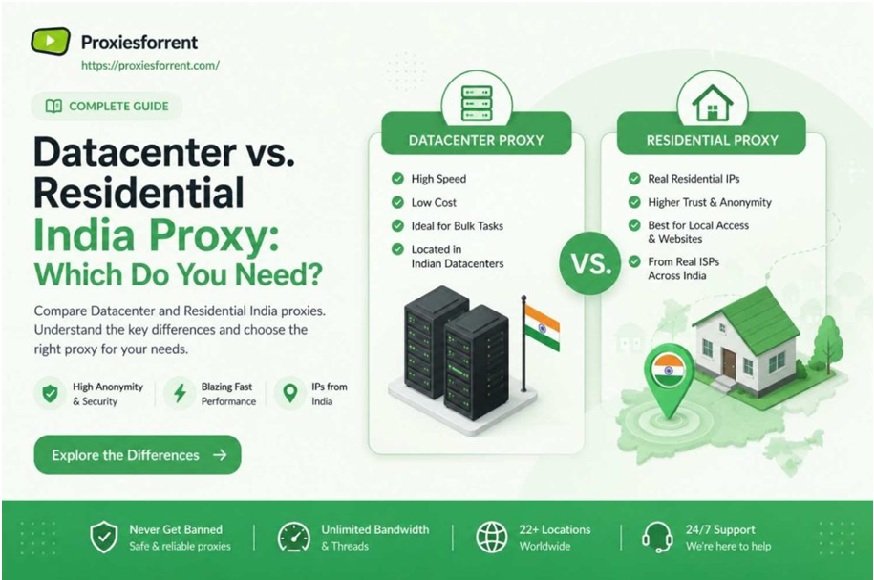
| Feature | Datacenter Proxy | Residential Proxy |
| IP Source | Hosted on data center servers | Assigned by real Indian ISPs |
| Speed | Faster overall | A bit slower, but more natural-looking |
| Detection Risk | Easier for platforms to flag | Blends in as a genuine user |
| Cost | More budget-friendly | Higher price point |
| Ideal Use | Speed-driven, general tasks | Account handling, avoiding bans |
If you’re running something that platforms actively watch for, like operating several accounts or scraping at scale — a residential option is generally worth paying more for. For lighter jobs like checking region-locked pricing, a datacenter proxy is usually enough. If you’re weighing options, it helps to compare a PRIVATE PROXY setup against a SHARED PROXY before committing.
Why “Free India Proxy” Searches Usually Lead to Disappointment
Searching for a free india proxy turns up plenty of results, but they tend to share the same set of headaches:
Crowded connections. Free proxies get shared by huge numbers of users at once, which drags down speed and gets IPs flagged constantly.
They don’t last. An IP that works fine today can be dead by tomorrow — free lists go stale quickly.
Zero support. When something breaks, there’s nobody to reach out to for help.
Questionable privacy. Free providers rarely explain what data they collect or how your traffic gets handled — and running servers costs money somehow, even when you’re not the one paying directly.
A paid india proxy sidesteps every one of these issues by offering dedicated IPs, reliable uptime, and actual support when things go sideways.
What to Check Before Choosing an India Proxy Provider
Size and Freshness of the IP Pool
With the use of more IP addresses and frequent updates, your chances of connecting to a banned IP address will be much smaller.
Verified India-Based IPs
Be sure that the IPs are actually registered to India, and not merely flagged as such. The problem with some inexpensive providers is that they send traffic via other areas without having any actual presence there.
Protocol Options
Check whether the provider supports HTTP, HTTPS, and SOCKS5. Having a SOCKS PROXY option available gives you more flexibility depending on the app or platform you’re working with.
Speed and Bandwidth Limits
Line up your expected usage against the provider’s bandwidth caps, especially if you’re running scraping tasks or managing accounts continuously.
Read More: Generative engine optimization and AI search optimization strategies for modern digital presence
Support Availability and Uptime Promises
For anything business-critical, round-the-clock support and a solid uptime guarantee matter far more than they seem to at sign-up — you’ll appreciate them the moment something stops working.
Key Takeaways
- The proxy for India will have an IP address based in India. This proxy will assist in conducting tests and managing accounts from India.
- Data center proxies triumph in terms of speed and cost; residential proxies triumph in terms of anonymity.
- Free proxies for India have many disadvantages and pose privacy risks.
- Paid india proxy server providers deliver real uptime, support, and authentic IPs
- When choosing an IP, consider its size, whether the IP is authentic, protocols that are supported, and quality of customer support.
FAQ
Why does one need an India proxy? It is generally used to divert traffic based on the IP address in India to check regional availability, use several accounts, have access to regionally blocked data, and carry out market research.
Is using an Indian proxy legal? Yes. Proxies are a widely used, legal tool. Just make sure your activity stays within the terms of service of whatever site or platform you’re accessing.
What separates a datacenter proxy from a residential one? A datacenter proxy runs on IPs assigned by server infrastructure — fast and affordable. A residential proxy uses IPs tied to real Indian internet providers, making it look more like an actual person browsing.
Can I safely use a free india proxy? You can, but expect weak performance since these are shared among large numbers of users. They’re best treated as a backup option rather than a main solution.
How do I confirm my India proxy is actually working? Once connected, search “what is my IP” in your browser. If it shows an Indian location instead of your real one, the proxy is functioning correctly.
Why do free India proxy lists die out so fast? Their IPs get discovered and blocked quickly, and the people maintaining these free lists usually have little incentive to keep refreshing them.
Should I go with residential or is datacenter enough? It depends on the task. Residential proxies suit anything requiring low detection risk, while datacenter proxies are fine for simpler jobs like checking regional prices.
How much bandwidth should I budget for an India proxy? It depends on the usage — leisure browsing requires much less than automated crawling or account management. Make sure that you choose a plan that will suit your needs.
Conclusion
Having an india proxy is among the easiest methods to obtain an authentic Indian IP, be it for service testing, account management, or accessing geo-restricted content. The difference between the two will manifest itself immediately — not only in speed, but in what will happen in case of a breakdown. Getting a dedicated Indian IP is what gives credibility to everything.
Ready for an India proxy that won’t get blocked in a day? Explore Proxiesforrent’s India proxy plans for genuine Indian IPs, flexible protocol support, and real customer support whenever you need it.